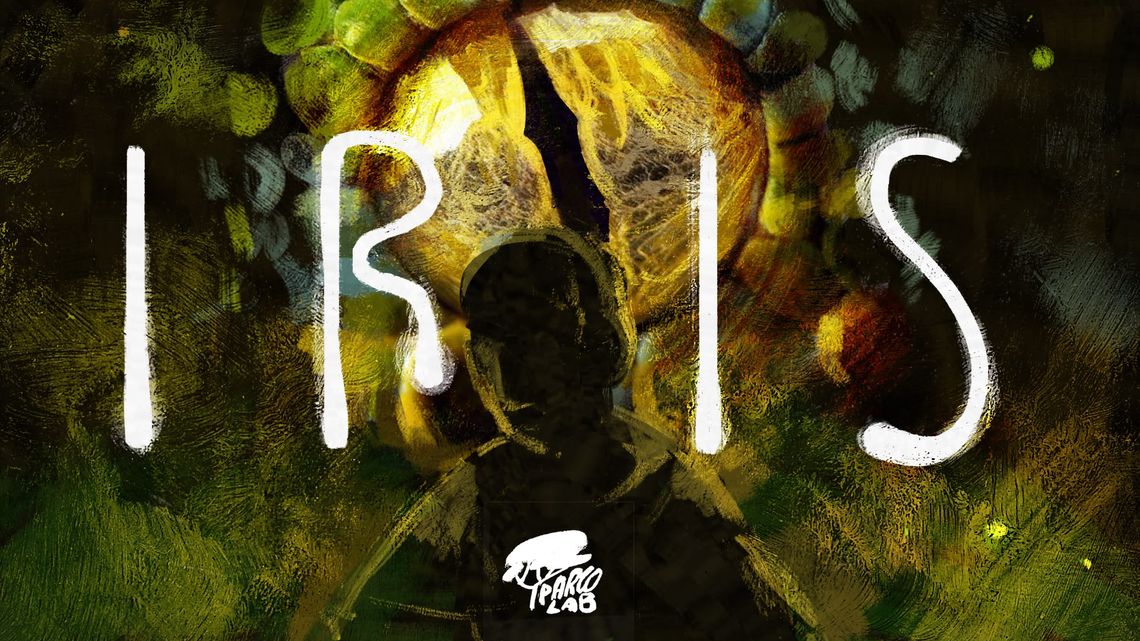
[Texto disponível apenas em inglês] IRIS is an immersive audiovisual performance built around a simple gesture: observation.
The project explores perception through a succession of eyes and environments inspired by the animal world. The viewer does not simply observe, but progressively enters into different ways of looking: each eye becomes a threshold to a different interpretation of space.
The performance begins in the depths of the sea. A dark, rarefied atmosphere envelops the room, while the monumental eye of a whale slowly emerges. The environment takes shape through a representation of sonar, transforming the space into a vision of waves and presences. The soundtrack follows this immersion with deep environments and aquatic sounds inspired by whale calls, creating a muffled, suspended dimension.
The scene then opens up to other environments and forms of perception. The eyes of prey, mammals, reptiles, and insects emerge from the darkness as the surrounding habitat is reinterpreted through their gaze: heat becomes color, the environment transforms into a sensory map, reality is fragmented through a compound eye, and the visible spectrum expands beyond our experience.
The environment remains essential: branches, leaves, water, flowers, and other natural forms suggest space without completely defining it. The eye remains monumental, observing and dominating the scene, while the iris becomes an autonomous narrative space: within it live organic, geometric structures and chromatic transformations, creating a continuous relationship between the eye and the environment.
The marine environment gradually gives way to natural sounds, constructing a more open and earthly landscape. Sound now allows the environments and the different perceptions to breathe.
The gaze changes nature. Don't observe, search. The perception of the environment gives way to the predatory instinct: the images become denser, the colors shift toward warmer tones, and the visual language becomes more rhythmic and aggressive. The sound component follows the same movement, introducing pulsations, rhythm, and intense beats.
In the climax, multiple eyes open in the room, creating a space of gazes. Some belong to the animal world, others evoke the human eye: the distinction is lost.
The project was designed to be developed as a live performance: the eyes and environments are constructed as independent modules and controlled by the performer, allowing for real-time alterations in animations, colors, intensity, and environments. Some elements react to the sound component, creating dynamic variations between rhythm, movement, and image.
The live dimension gives the eyes and environments a vital state: they are active elements that change, react, and assume different states during the performance. The performer becomes part of this process, giving the performance a recognizable but not predetermined structure.
A constant visual grammar is constructed that constantly evolves, progressively transforming the very way of looking: no longer simply observing the world, but attempting to perceive it through other eyes.
Digital Biomorphic Surrealism
The starting point is biomorphism: life-inspired, organic, irregular, fluid forms. The second level is surrealism: these forms can deform, change scale, merge, and behave in impossible ways. The third level is digital, which does not mean adding digital effects, glitches, or technological aesthetics, but rather exploiting what digital allows us to do with matter, light, movement, and space.
Taking from biomorphism, we get organic forms. Taking from surrealism, get alteration of reality. Taking from expressionism,fauvism, we get color that is not always realistic;
Example: Whale: A huge digital eye occupies the wall.
The anatomical structure is recognizable but simplified.
The iris is composed.